
Setting up a company in Andorra

Setting up a company in Andorra: the complete guide to procedures, costs and tax

Setting up a company in Andorra means registering an SL (minimum capital of €3,000) or an SA (€60,000) with the Companies Register, after a foreign investment authorisation. The company pays corporate tax at the general rate of 10 %. To obtain active residency you must hold more than 34 % of it and run it.

This guide follows the real order of the steps, from choosing the legal form to opening the business account. It gives the costs item by item, how the director is paid, and the conditions for active residency, updated for the 2025 and 2026 reforms.
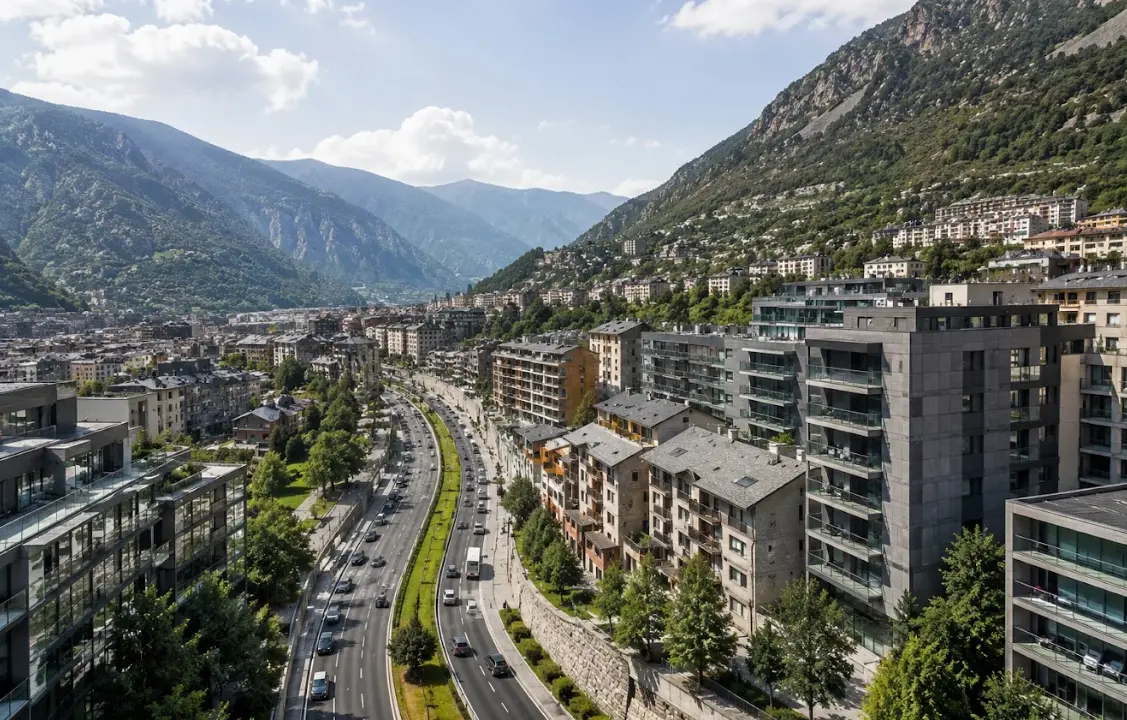
Andorre-la-Vella, capitale de la Principauté d'Andorre
Andorra la Vella, capital of the Principality
10 %
Corporate tax
general rate, against 25 % in France
€3,000
Minimum capital of an SL
locked, then usable again
> 34 %
Shareholding required
for active residency (Llei 5/2025)

The heart of the matter

Why set up a company in Andorra

The Principality attracts directors for one simple reason: a business keeps a far larger share of what it earns. Here is what actually changes compared with a French company.

An Andorran company is taxed on its profits at the general rate of 10 % (Llei 95/2010 on corporate tax). In France, the standard rate of corporate tax reaches 25 %. On a profit of €200,000, the gap means €30,000 kept each year, reinvested in the business rather than paid to the Treasury. It is the main driver of companies relocating to Andorra.

The consumption tax, IGI (impost general indirecte, the local equivalent of VAT), stands at 4,5 %, against 20 % in France. A company invoicing services from Andorra therefore applies a rate four times lower, which lightens the final cost for its clients and simplifies its administration.

Paying out dividends follows the same moderate logic. A resident director declares dividends under IRPF in the savings base: 10 % above a €3,000 allowance. Anyone splitting their pay between salary and dividends has room to manoeuvre that the French system no longer offers. The detail is further down, in the section on paying the director.

A mistake that is still common: the reduced 5 % rate for new companies in their first three financial years no longer exists. It was repealed by Llei 17/2017 for financial years opened from 1 January 2017. A company set up in 2026 pays the general rate of 10 %.

The company as the gateway to active residency

Setting up and running an Andorran company opens the way to active residency, the status reserved for those carrying on an economic activity in the country. The company is therefore not only a tax tool, it becomes the legal basis for the whole move. The conditions in figures are set out in the section on company and active residency.

Choosing your structure

Legal forms: SL, SLU or SA

Two forms cover almost every project. The Societat Limitada (SL) for small businesses and the self-employed, the Societat Anònima (SA) for large operations. The choice depends on the capital you put up and the scale of the project.

CriterionSL / SLUSA
Minimum capital 3 000 € 60 000 €
Who it suits Small businesses, the self-employed, family holdings, service companies Large projects, fundraising, wide shareholder base
Sole shareholder Yes, the SLU (Societat Limitada Unipersonal) is the single-shareholder version Possible (SAU, Societat Anònima Unipersonal), rarely worthwhile at this level of capital
Transfer of shares Regulated, existing shareholders have priority Freer, shares are transferable
Governance Flexible, one or several directors Formal structure, board of directors possible

When to choose the SL or SLU. The great majority of founders go for an SL. It is enough for a consultancy, an agency, an online shop, a trading activity or a family holding. If you are alone at the helm, the SLU gives you the same structure without a token partner. The €3,000 capital is modest and it is not lost: it then funds the running of the company.

When to choose the SA. The Societat Anònima makes sense when the project involves substantial capital, plans to open its share base or targets a large operation. Its €60,000 capital and heavier formalities suit an industrial project or a company set to bring in investors.

How to proceed

The formation steps, one by one

Seven steps separate the idea from the registered company. Each depends on the one before, and two of them involve the Andorran administration. Here is the real order of operations.

01

Reserve the company name

You submit three names in order of preference to the Register. The name is written in Catalan, must not be too generic and must reflect the activity. The administration checks that no company already uses it and issues a reservation certificate. Nothing can move forward before this is cleared.

02

Apply for foreign investment authorisation (IDE)

As soon as a non-resident directly holds more than 10 % of the capital, formation requires prior foreign investment authorisation (Llei 5/2025, title I, which repealed Llei 10/2012). The ministry rules within two months, extendable by half, and silence counts as refusal. This is often the step that weighs most on the timetable.

03

Deposit the capital in a blocked account

You open a deposit account with an Andorran bank and block the share capital there, €3,000 for an SL. The bank issues a deposit certificate required by the notary. The funds are released once the company is registered.

04

Incorporate before a notary

The Andorran notary draws up the deed of incorporation, the articles and the share split. They verify the identity of the shareholders, the investment authorisation and the deposit certificate. You sign the public deed that brings the company into being.

05

Register with the Companies Register

The notary sends the deed to the Registre de Societats Mercantils, which records it within about fifteen days. Registration gives the company legal personality and makes it enforceable against third parties. The company now officially exists.

06

Obtain the NRT, the tax number

The company receives its Número de Registre Tributari, the Andorran tax identifier. Invoicing, IGI returns and payment of corporate tax all depend on it. Without an NRT, no declared activity is possible.

07

Open the business account

The blocked deposit account becomes a current trading account, or you open a dedicated one. Andorran banks apply a strict compliance process: proof of the origin of funds, description of the activity, an interview with the account manager. Once the account is live, the company takes payments, pays suppliers and pays salaries. The business is operational.

The documents for the file

The file is prepared before the first step, because a missing document sends the investment authorisation back for review. For the director and for each shareholder, plan for:

  • a criminal record extract from the country of origin;
  • a valid passport;
  • a business plan describing the activity, the budget forecast and the investment strategy;
  • the draft articles and the chosen company name;
  • the capital deposit certificate issued by an Andorran bank.

Foreign documents must carry the Hague apostille. Allow for three months of validity: a criminal record apostilled too early will have to be requested again.

The recurring question

Can you set up a company without living in Andorra?

Yes, a non-resident can own and run an Andorran company. No, that does not automatically bring the tax advantages. The distinction is crucial and many sites gloss over it.

Formation itself remains open to non-residents. After obtaining foreign investment authorisation, a French entrepreneur based in Paris can perfectly well hold shares in an Andorran SL and manage it. On that front, nationality and place of residence block nothing.

Tax, on the other hand, follows the person, not the company on paper. For your income to benefit from Andorran rates, you must become a tax resident of the Principality. That means living there more than 183 days a year or establishing the centre of your economic interests there, the two criteria being alternatives, and having real substance: an office, an actual activity, a tangible presence. An Andorran company run from France, with no real establishment, exposes its owner to reclassification by the French authorities, who will treat it as French for tax purposes.

In plain terms: owning an Andorran company without living there is legal, but it does not reduce your personal tax. The tax advantage is earned through a real move. It is that stage, residency and substance, that turns the company into a compliant planning tool.

Transparency

What does setting up a company really cost?

The budget splits into two quite separate blocks: the share capital, which you get back, and the administrative costs, which are your real outlay. Here is the breakdown, item by item.

ItemIndicative amountNature
Share capital (SL) 3 000 € Locked at formation, then usable again by the company. It is not an expense.
Investment authorisation (IDE) 300 € Government processing fee for foreign investment.
Notary fees 400 à 900 € Drafting and signing the deed of incorporation.
Advisory fees 1 500 à 2 500 € The firm steering the steps, the notary, the bank and the Register.
Annual duties variable Economic activities register duty and local council tax, depending on the company form, the parish and the floor area of the premises.
Administrative total 2 500 à 3 500 € Real cost, excluding recoverable share capital.

Hold on to the logic: the €3,000 capital is not lost. It then funds the company's first expenses. Your net outlay, the money that definitively leaves your pocket, sits between €2,500 and €3,500 for an SL set up properly. Many providers advertise a very low entry price then add costs along the way. An honest quote includes the notary, the investment authorisation, registration and advice from the outset.

Indicative amounts for a standard SL, to be confirmed according to the nature of your project and the detail of your file. Notary and processing fees vary from case to case.

The timetable

How long does it take to set up a company?

In the files we handle, allow three to six months between reserving the name and opening the business account. Two deadlines are set by law, the others depend on the quality of the file.

StepTimeWhat sets it
Foreign investment authorisation2 monthsLlei 5/2025: the ministry rules within two months, extendable by half, and silence counts as refusal
Registration with the Companies Register≈ 15 daysAfter the notary sends the deed
Name, notary, NRTa few weeksAvailability of the name and of the notary
Opening the bank accountvariableThe bank's compliance process, origin of funds

Three things regularly stretch the timetable: an incomplete investment file sent back for review, a bank asking for extra supporting documents, and a regulated activity needing a sector authorisation. A file prepared seriously from the start stays at the lower end.

A necessary clarification

Andorra is not an offshore arrangement

The word “offshore” comes up in many searches about Andorran companies. It is misleading. A company formed in Andorra is nothing like a shell in an opaque haven. The Principality has changed its tax status and now plays the international cooperation card.

Création de société en Andorre : risques et vérité7:27 Setting up a company in Andorra: risks and the truthVirginie Hergel · 7 min
  • Automatic exchange of information. Andorra passes the banking data of its foreign residents to their countries of origin under the OECD common standard. The bank secrecy of old no longer exists.
  • Tax treaties. The Principality has signed a double taxation treaty with France, in force since 2015, as well as with Spain and other countries. Each type of income is taxed in a defined place, with no way out.
  • Substance requirement. An Andorran company must carry on a real activity in the territory to be recognised. An office, staff or a director present, an actual activity: without that, the authorities in the country of origin reclassify the structure.
  • Off the grey lists. Andorra no longer appears on the OECD lists of non-cooperative jurisdictions. Its tax rates are low; they are neither hidden nor unlawful.

The difference from an offshore arrangement fits in one sentence: in Andorra you hide nothing, you genuinely settle in a low-tax country. It is a real, declared and compliant change of life, not an accounting device.

Wealth structuring

The holding company in Andorra

An Andorran holding is an SL or an SA that holds stakes in other companies and centralises their dividends. Those dividends are fully exempt from corporate tax when three conditions are met (art. 20 of Llei 95/2010): a holding of at least 5 %, held for at least one year, in a subsidiary subject to a similar tax at a nominal rate of at least 5 %. If a single condition is missing, the exemption falls away and the dividends are taxed at 10 %.

The holding remains subject to the same requirements as any Andorran company: real substance and the director actually resident. A holding with no activity and no presence brings no advantage, it creates a reclassification risk. Use cases, risks and the treatment of non-residents are set out in our article holding companies in Andorra: advantages and risks.

Address and premises

Registered office and company address

Every Andorran company must have a real address in the territory. The registered office appears in the articles and conditions registration. A simple PO box is not enough: the administration expects identifiable premises where the company can be reached and where it is managed from.

Depending on the activity, the address takes the form of a rented office, a shared space or commercial premises. This requirement meets the substance one: the Andorran address is not a formality, it embodies the company's roots in the country and weighs on the recognition of its tax residency. To compare workspaces and compliant registered-office options, see our guide to coworking and registered offices in Andorra.

Salary, dividends, contributions

Paying the director of an Andorran company

The director is paid through salary, through dividends, or both. Each route has its own tax and contribution rules.

IncomeTax (IRPF)CASS contributions
Salary 0 % up to €24,000, 5 % effective between €24,000 and €40,000, 10 % above 22 % of gross pay: 15,5 % employer, 6,5 % employee
Dividends Savings base: 10 % above €3,000 None

The salary scale does not have three statutory bands. It follows from three rules in Llei 5/2014: a personal allowance of €24,000 (art. 35), a rate of 10 % (art. 43) and a 50 % relief capped at €800 (art. 46). It is that cap which puts the line at €40,000: on a €40,000 salary, the tax comes to €800.

Dividends get neither the €24,000 allowance nor the relief. Only the first €3,000 of the savings base is exempt (art. 37). A shareholder paying themselves €30,000 in dividends therefore pays €2,700 in tax.

On contributions, a shareholder running their own company generally falls under the CASS self-employed scheme. The overall rate is 22 %, applied to a base set each year on the average wage: the full-rate contribution comes to €587.95 a month according to the scale published by CASS, with reduced bands for modest incomes. The choice between salary and dividends is made case by case, depending on the income sought and the social cover wanted.

From company to arrival

Company and active residency: the direct link

Setting up and running a company opens the way to active residency per compte propi, the status of those working in Andorra on their own account. The company becomes the legal reason for your move.

Three conditions in figures frame this route in 2026:

  • a holding above 34 % of the Andorran company's capital, together with an effective management role. The 20 % threshold still quoted by many guides was raised by Llei 5/2025;
  • a non-refundable payment of €50,000 to the AFA, made when the application is filed and kept by the State unless the initial authorisation is refused. It is not required where the company's purpose is the digital economy, entrepreneurship or innovation;
  • an annual quota: 150 authorisations for other cases in 2026, out of 200 split between liberal professions, doctors and other cases (Decret 75/2026), a split declared fixed. Once the quota is used up, applications wait for the following year.

Do not confuse this route with residency without gainful activity, known as passive, which since 13 February 2026 requires an investment of at least €1,000,000 in Andorra (Llei 2/2026). Active residency does not ask for that investment, it asks for a real activity.

The process runs in two linked stages: the company first, residency second. For the profiles, the supporting documents and the presence required, see our guide to residency in Andorra.

Our support

How Setup Andorra works with you

Knowing the steps is not the same as taking them. Between the investment authorisation, the notary, the bank and the Register, a poorly prepared file drags on for months. Setup Andorra takes the project on from end to end.

A single point of contact handles your company, your residency, the opening of your bank account and your move on the ground, from the first question to the first day of trading. The firm is based in Andorra, it knows the notaries, the banks and the administration, and it prepares each file so that it goes through first time. You keep control of the decisions, the team handles the execution.

Virginie Hergel, fondatrice de Setup Andorra
Virginie Hergel, founder of Setup Andorra

A firm based in Andorra, not a remote intermediary

Founder Virginie Hergel and her team support people settling in the Principality. A local presence, a proven method, results measured by those who have done it.

5,0
from 111 Google reviews
Le Parisien · M6 · Forbes
media covering us
Andorra
a firm on the ground

Frequently asked questions

Your questions about setting up a company

What does it cost to set up a company in Andorra?

The real administrative cost sits between €2,500 and €3,500 for an SL, including notary, investment authorisation, registration and advice. On top of that comes the €3,000 share capital, which remains the company's property and then funds its running costs.

Can you open a company in Andorra without being resident?

Yes. A non-resident can own and run an Andorran company after obtaining foreign investment authorisation. Benefiting from Andorran tax rates, however, means becoming a tax resident, that is living more than 183 days a year in the Principality with a real activity on the ground.

What are the tax advantages of an Andorran company?

Corporate tax applies at the general rate of 10 %, against 25 % in France. IGI, the local equivalent of VAT, has a general rate of 4,5 %. A resident director pays 10 % IRPF on dividends above €3,000. These advantages apply in full only to tax residents of the Principality.

How long does it take to set up a company?

Allow three to six months. Foreign investment authorisation is granted within two months, extendable by half, and registration takes about fifteen days. The banking process, very thorough in Andorra, accounts for the rest. A well-prepared file stays close to three months.

Is there a minimum capital to set up a company?

Yes. An SL or SLU requires a minimum capital of €3,000, an SA €60,000. That capital is blocked in an Andorran bank account during formation, then released as soon as the company is registered. It is not an expense, but a sum to put up before the company even exists.

Can a French national set up a company in Andorra?

Yes. French nationality is no obstacle. After obtaining foreign investment authorisation, a French national sets up their SL like any other investor. To benefit from the tax rates, they will have to move their tax residency to Andorra and carry on a real activity there.

Is an Andorran company an offshore arrangement?

No. Andorra applies automatic exchange of banking information, has signed double taxation treaties and requires real substance from its companies. The Principality no longer appears on the OECD grey lists. Tax rates are low, but they are declared and compliant.

Which legal form should you choose, SL or SA?

The SL, with its €3,000 capital, covers almost every project for small businesses, the self-employed and holdings. The SLU is its single-shareholder version. The SA, with €60,000 of capital, is for large projects and companies opening up their share base.

What shareholding do you need for active residency?

More than 34 % of the Andorran company's capital, with an effective management role. That threshold, set by Llei 5/2025, replaces the former 20 %. To it are added a non-refundable payment of €50,000 to the AFA, except for companies in the digital economy, entrepreneurship or innovation, and a quota of 150 authorisations in 2026 for other cases, out of 200 in total.

Does the reduced 5 % rate for new companies still exist?

No. That regime, which cut corporate tax to 5 % for the first three financial years, was repealed by Llei 17/2017 for financial years opened from 1 January 2017. A company set up in 2026 pays the general rate of 10 %.

Go from project to registered company

In a free consultation we look at your project, cost it properly and define the right structure, company and residency included. You leave with a clear plan, not a vague estimate.

Book my free consultation →

A firm based in Andorra · End-to-end support · 5.0 from 111 Google reviews

Scroll to Top
Let's talk about your project