Taxation · Principality of Andorra

Taxation in Andorra: the guide to taxes and tax residence

Andorran taxation rests on three low-rate taxes: corporate income tax at 10 %, IRPF (personal income tax) capped at 10 % above 40 000 € of income, and IGI (the local VAT) at 4,5 %. The double taxation treaty between France and Andorra, in force since 2015, governs the tax situation of French residents settled in the Principality.

10 %IS — companies
0–10 %IRPF — income
4,5 %IGI — VAT
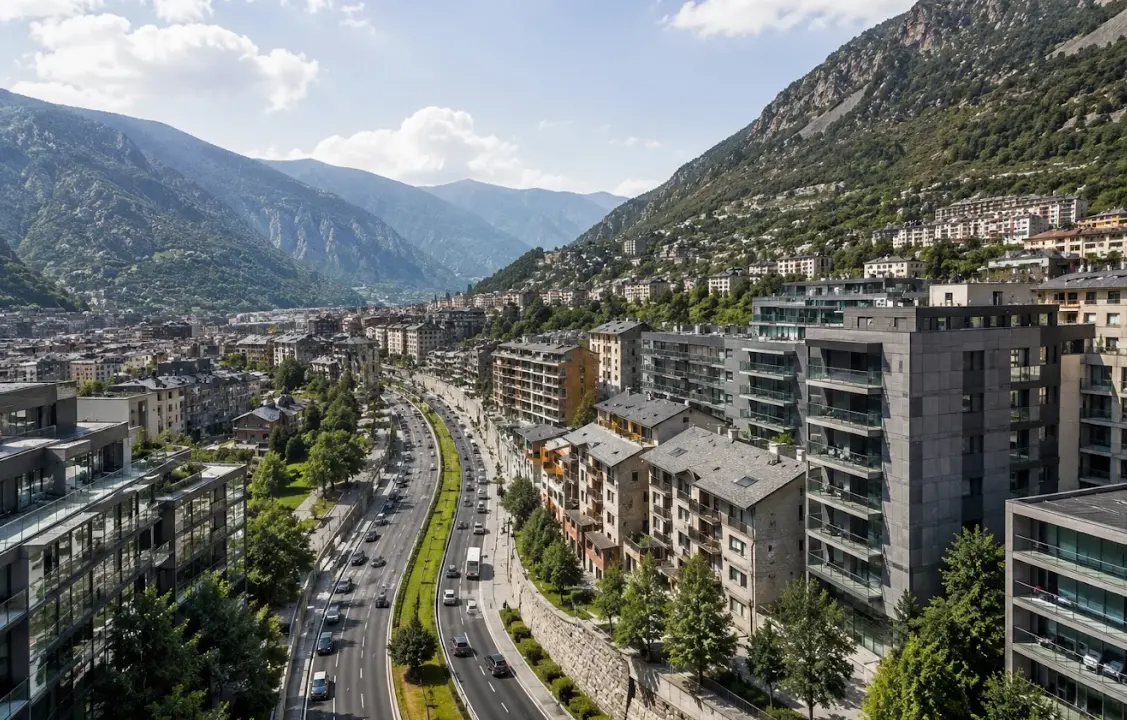
Andorra la Vella, capital of the Principality of Andorra
Andorra la Vella, capital of the Principality.
10% max
Corporate income tax
General rate of 10 % on profits, versus 25 % in France and Spain.
0–10% IRPF
Personal income tax
Three-band scale: 0 % up to 24 000 €, 5 %, then 10 % above 40 000 €.
4,5% IGI
Andorran VAT
The lowest VAT in Europe, versus 20 % on the French side and 21 % on the Spanish side.

The tax system

The three Andorran taxes

The Andorran tax system rests on three levies, against a good fifteen in France. A tax on company profits, a tax on the income of individuals, a tax on consumption. No wealth tax. No inheritance tax in the direct line. No property tax comparable to the one French owners face. This simple architecture explains a good part of Andorra’s tax appeal.

The three taxes in force — Principality of Andorra
Tax What it taxes Rate
ISCorporate income tax Company profits 10 %general rate
IRPFPersonal income tax Individuals’ income 0 · 5 · 10 %
IGILocal VAT Consumption of goods and services 4,5 %general rate

Corporate income tax (IS): 10 % versus 25 % in France

Andorran corporate income tax hits a company’s profits at the general rate of 10 %. In France, the same profit bears 25 %. In Spain, 25 % as well. The gap speaks for itself.

Take a consulting firm that generates 200 000 € of net profit. In Andorra, it pays 20 000 € of IS. In France, it pays 50 000 €. Difference over one year: 30 000 € that stay in the company’s cash rather than going to the public purse. Over five years of stable activity, the cumulative gap exceeds 150 000 €.

The mechanism stays classic: you calculate a taxable result, you apply the rate. The difference lies in the rate itself and a few special regimes. Certain holding companies or companies exploiting intangible assets benefit from lighter treatment. The minimum share capital of an Andorran limited liability company is 3 000 €. The detail of the legal forms and the procedures appears in our guide to setting up a company in Andorra.

A point of caution: the low rate is not enough. The Andorran authorities require substance. A company that invoices from Andorra but whose entire real activity takes place elsewhere exposes itself to a tax adjustment, in Andorra as in the home country. An office, an employee, decisions taken on site: the structure must live where it is domiciled. On compliant registered-office options, see our guide to registered offices.

IRPF: a personal income tax capped at 10 %

IRPF is the Andorran tax on the income of individuals. It works in bands, like the French scale, but with thresholds and a cap that have no equivalent in France:

  • 0 % up to 24 000 € of annual income
  • 5 % on the portion between 24 000 € and 40 000 €
  • 10 % on everything above 40 000 €

A worked example makes the mechanics concrete. A resident earns 60 000 € in taxable income. Their first band (24 000 €) is not taxed. The second (16 000 €) bears 5 %, that is 800 €. The balance (20 000 €) bears 10 %, that is 2 000 €. Total: 2 800 € of income tax, an effective rate of 4,67 %. The same 60 000 € income in France, for a single person with no dependants, falls into the 30 % band and leaves a much heavier bill once the progressive scale is applied.

The Andorran 10 % cap changes the logic for high incomes. In France, the scale rises to 45 %, on top of which comes the exceptional contribution on high incomes. In Spain, state tax plus regional tax exceeds 47 % on the top bands. In Andorra, the marginal rate stops at 10 %, whatever the amount of income. For a director who pays themselves 300 000 € a year, the gap becomes decisive.

Dividends of Andorran source benefit from favourable treatment, often an IRPF exemption to avoid the economic double taxation already borne at company level.

IGI: the local VAT at 4,5 %

IGI (Impost General Indirecte) is the Andorran tax on consumption, the equivalent of VAT. Its general rate is 4,5 %. In France, standard VAT is 20 %. In Spain, 21 %. It is the lowest VAT rate in Europe.

In concrete terms, on a purchase of 1 000 € before tax, an Andorran consumer pays 45 € of IGI. The same purchase in France costs 200 € of VAT. This gap explains why Andorra remains a shopping destination for electronics, perfumes, tobacco and spirits, and why retail weighs so heavily in its economy.

IGI has several rates:

  • 0 %: super-reduced rate, on residential rentals, medicines reimbursed by the CASS and certain health and education services
  • 1 %: reduced rate, on food products, water, books, newspapers and magazines
  • 2,5 %: special rate, on transport and certain cultural services
  • 3,5 %: specific rate, on the purchase of a home intended for permanent residential rental, under conditions
  • 4,5 %: general rate, on most goods and services
  • 9,5 %: increased rate, on banking and financial services

For a business, IGI is handled like VAT: charged on sales, deducted on purchases, with the difference paid over. The administrative burden stays light compared with the French system, notably because the rates are few and the thresholds clear.

Indicative data — a personalised review is needed for your situation.

Andorra · France · Spain

Andorra vs France vs Spain: the tax comparison

Putting the three systems side by side shows the real scale of the gap. The table below compares the main levies that weigh on a director or a high-income individual. Andorra in orange, its two neighbours in midnight blue and grey.

Andorra France Spain

Corporate income tax

Andorra
10 %
France
25 %
Spain
25 %

Personal income tax — top marginal rate

Andorra
10 %
France
45 %
Spain
47 %

VAT / IGI — general rate

Andorra
4,5 %
France
20 %
Spain
21 %
Full comparison of the main levies
Tax Andorra France Spain
Corporate income tax 10 % 25 % 25 %
Personal income taxmarginal rate 10 % 45 % 47 % and above
VAT / IGIgeneral rate 4,5 % 20 % 21 %
Capital gains on securities Often exempt under conditions 30 % (flat tax) 19 % to 28 %

On capital gains, the comparison calls for nuance. In Andorra, the sale of securities is generally exempt from tax when the seller holds a stake below a certain threshold. Andorran real-estate capital gains, for their part, follow a scale that decreases with the holding period. In France, the 30 % flat tax applies to most capital gains on securities.

The real question

Is Andorra a tax haven?

No. The answer is clear, and it rests on verifiable facts, not on a sales pitch.

Andorra has come off the OECD grey lists. The country has applied the automatic exchange of banking information (CRS standard) since 2018. In other words, accounts held by non-residents are reported automatically to their home authorities. The banking secrecy that long clung to the Principality’s image no longer exists. A French tax resident who kept an undeclared Andorran account would be flagged to the French tax authorities.

A tax haven, in the strict sense, combines three traits: zero or near-zero taxation, opacity, and no exchange of information. Andorra ticks none of these boxes. Taxation there is real (10 % does not mean 0 %), information circulates, and the country has signed a series of tax treaties, including the one with France. The confusion comes from the country’s old reputation, from before the reforms of the 2010s.

What Andorra offers is low, transparent taxation, backed by demanding residence rules. That is not the same thing as a tax haven, and this distinction is precisely what protects those who settle there properly.

CRS transparencyAutomatic exchange of banking information since 2018.
Off the OECD grey listsRecognised cooperative jurisdiction.
Tax treatiesDouble taxation agreements, including with France.

Tax residence

Becoming a tax resident in Andorra: conditions and steps

Andorran tax residence rests on two cumulative conditions. Living more than 183 days a year in the Principality. Placing the centre of your economic interests there. Both count, and the administration checks both.

The 183-day rule is the physical-presence test. Over a calendar year, the resident must spend more than half their time in Andorra. This is documented: bills, bank movements, spending, actual presence. A “paper” resident who in fact lived in Paris or Barcelona runs a serious risk of reclassification.

The centre of economic interests is the second criterion. It refers to where professional activity, the main source of income and the assets managed are concentrated. An operational Andorran company, a local bank account, a home in your name: these elements build the body of evidence. Combining the two criteria secures the status against the French authorities, which apply their own tax-residence tests and do not hesitate to challenge a poorly prepared expatriation.

On the procedural side, obtaining a residence permit goes through filing an application with the Andorran government, a medical examination, a criminal-record extract, and depending on the status sought, an investment or a professional activity on site. The timeframes and documents vary according to the residence profile chosen.

Andorra la Vella, administrative district
Andorra la Vella, the administrative district.

Residence statuses

The four residence profiles

Andorra distinguishes several residence statuses, each tailored to a situation. Choosing the right one from the start avoids having to rebuild an application midway.

01

Active residence

Active residence is for those who work in Andorra or run a company there. It is the status of the director, the entrepreneur, the employee. It requires setting up an Andorran company or a local employment contract, affiliation to the social security fund (the CASS), and an actual physical presence on the territory. The active resident contributes to the CASS, which gives them Andorran health cover and pension rights. The CASS contribution rate for a self-employed worker is around 22 % of a calculation base.

Directors · Entrepreneurs · Employees
02

Passive residence

Passive residence, or residence without gainful activity, is aimed at those who live in Andorra without working there: people of private means, retirees, investors whose income comes from abroad. This status requires a shorter minimum presence than active residence, of the order of 90 days a year. Since the 2025-2026 reform, in return it requires an investment of at least 1 000 000 € in Andorran assets (real estate, shareholdings, financial products or public debt), reduced to 400 000 € if placed in the Fons d’Habitatge, as well as a final, non-refundable payment to the Andorran financial authority (AFA) of 50 000 € for the main applicant, plus 12 000 € per dependant.

Private means · Retirees · Investors
03

Athletes and artists

This status targets elite athletes and artists whose activity reaches an international audience. A professional cyclist, a driver, a recognised creator who carries out most of their career outside Andorra falls into this category. The presence and investment conditions differ from the classic passive regime, with terms adapted to income generated all over the world.

Athletes · Artists · Public profile
04

International reach

This profile concerns professionals who run an outward-facing activity from Andorra. The classic rule is that a large share of turnover, often cited at around 85 %, must be generated outside Andorran territory. Consultants, digital service providers and entrepreneurs whose clients are abroad find here a framework that recognises the international nature of their work.

Consultants · Digital services

Real-world cases

What taxation changes depending on your profile

The Andorran tax regime does not produce the same effect for everyone. The gain depends on the nature of your income and the structure of your activity.

The company director

They combine two levers. Their company pays 10 % IS instead of 25 %. The remuneration they pay themselves is capped at 10 % IRPF instead of climbing to 45 % in France. On a profit of 300 000 € split between company and salary, the annual saving runs into tens of thousands of euros. This is the profile for whom moving to Andorra has the heaviest impact.

The retiree

A pension of foreign source, governed by the tax treaty, falls under the Andorran IRPF scale, with its 24 000 € exempt and its 10 % cap. The absence of wealth tax and of inheritance tax in the direct line weighs just as much in the decision, especially for a large estate to pass on.

The content creator

YouTuber, streamer, online trainer: their income comes from audiences and platforms spread across the world. International-reach residence fits this way of working. Their earned income falls under IRPF capped at 10 %, and their Andorran content-production company pays 10 % IS.

The investor and crypto trader

This is the profile for whom capital gains matter most. Andorra does not apply the French 30 % flat tax on sales of securities, and its treatment of capital gains is markedly gentler. For assets that turn over and are realised regularly, the gap with France becomes decisive.

Legal framework

The France-Andorra tax treaty and the exit tax

The double taxation treaty between France and Andorra was signed in 2013, came into force in 2015, and has applied since 2016. Its role: to prevent the same income being taxed twice, once in France and once in Andorra. The text allocates the right to tax between the two States according to the nature of the income (salaries, dividends, pensions, real-estate income) and sets the rules for settling cases of dual residence.

This treaty secures the expatriation. Without it, an Andorran resident of French nationality would remain exposed to a risk of double taxation on their French-source income. With it, the allocation is framed and enforceable. The resident knows which State taxes what.

One trap remains that many discover too late: the French exit tax. France taxes the latent capital gains of people who hold significant movable wealth at the moment they transfer their tax domicile out of France. In concrete terms, if you hold company securities of high value and leave France, the authorities consider that you could have sold them before leaving, and calculate a tax on the theoretical gain. A payment deferral exists under conditions, but the mechanism must be declared and anticipated.

Our position on this point is firm: the exit tax is prepared before departure, never after. The order of operations (date of residence transfer, any sale of securities, French filings) determines the final bill. An improvised expatriation on this ground is costly. This is precisely where structured support makes the difference between a clean relocation and a tax adjustment.

The Setup Andorra method

How Setup Andorra supports you

Settling in Andorra involves four workstreams that move forward at the same time: setting up a company, obtaining residence, opening a bank account, moving in on site. Run separately, they contradict each other (the bank waits for the company, the company waits for residence, residence waits for housing). Setup Andorra steers them together, with a single point of contact who keeps the overall view of the file.

01

Company

Setting up your Andorran structure, articles of association, registration, compliance with the substance requirements. See the company-creation guide.

02

Residence

Choosing the status suited to your profile, preparing and filing the application with the Andorran government, follow-up through to the residence permit. See the residence conditions.

03

Bank

Opening your account with an Andorran institution, often a sticking point without a local introduction. Understand the Andorran banks.

04

Relocation

Housing, everyday formalities, the practical setup of your life on site.

Setup Andorra is the brand of Set Up Expatriation S.L.U., an expatriation advisory firm that combines the skills of a gestoria and a concierge service. More than 100 5-star reviews document the work done for clients already settled. The firm has been featured by media such as Le Parisien, M6 and Forbes. It is led by its founder Virginie Hergel and draws on Eric Bartolomé, formerly of the Andorran government, whose knowledge of the country’s administrative workings secures every file.

Your tax situation deserves a precise costing before any decision. Book your free consultation and leave with a clear estimate of what Andorra changes for you.

Virginie Hergel, founder of Setup Andorra
Virginie Hergel, founder of Setup Andorra.
100+ Verified 5-star reviewsExpatriations handled from end to end, rated and recommended by our settled clients.
Seen in the press

Frequently asked questions

What people ask us

What tax rate applies in Andorra?

Three rates structure Andorran taxation. Corporate income tax is 10 %. Personal income tax (IRPF) runs from 0 % (up to 24 000 €) to 10 % (above 40 000 €), with a 5 % band in between. IGI, the local VAT, is 4,5 % at its general rate. No wealth tax, no inheritance tax in the direct line.

How long does it take to become a tax resident in Andorra?

Tax-resident status requires living more than 183 days a year in Andorra and placing the centre of your economic interests there. Obtaining the residence permit itself depends on the profile chosen and how the application is put together. Allow several weeks to a few months between filing and issue of the permit.

Is Andorra a tax haven?

No. Andorra has come off the OECD grey lists, has applied the automatic exchange of banking information (CRS) since 2018, and has signed tax treaties including the one with France. Taxation there is real and transparent, not zero and opaque. The country offers low taxation within a full reporting framework.

Can a French national set up a company in Andorra?

Yes. A French national can set up an Andorran company and hold its capital. Incorporation usually comes with an active-residence application to run the structure on site, and requires genuine substance (an office, an actual activity). The minimum share capital of a limited liability company is 3 000 €.

What is the difference between IGI and VAT?

IGI is the Andorran version of VAT. Same principle (a consumption tax collected by businesses), very different rate. General IGI is 4,5 % versus 20 % for French VAT and 21 % for Spanish VAT. IGI also applies a super-reduced rate of 0 % (residential rentals, medicines reimbursed by the CASS, certain health and education services), a reduced rate of 1 % (food, water, books and press), a special rate of 2,5 % (transport, cultural services), a specific rate of 3,5 % (purchase of a home intended for long-term rental) and an increased rate of 9,5 % (banking and financial services).

Does the exit tax apply when leaving for Andorra?

Yes, if you hold significant movable wealth at the moment you leave France. The French exit tax bears on the latent capital gains of your securities. It must be declared and anticipated before the transfer of tax domicile. A payment deferral exists under conditions. The order of operations drives the final cost, hence the value of preparing this point in advance.

Does the France-Andorra tax treaty prevent double taxation?

Yes. Signed in 2013, in force since 2015 and applicable since 2016, it allocates the right to tax between the two countries according to the nature of the income and sets the rules in cases of dual residence. It prevents the same income being taxed in France and Andorra, and gives the expatriation legal security.

Do you really have to live in Andorra to benefit from its taxation?

Yes. Tax residence requires a real presence of more than 183 days a year and a centre of economic interests on site. A fictitious residence exposes you to reclassification by the French authorities, which apply their own criteria. The Andorran regime rewards a genuine relocation, not a façade domicile.

First discussion free

Your Andorran project starts with a conversation

Thirty minutes with a Setup Andorra expert to assess your situation, quantify your tax saving and map out the next steps. No obligation.

By Setup Andorra
Scroll to Top